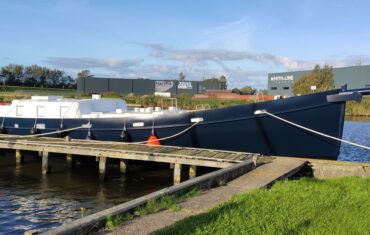
At the end of May, the Baltic left Deventer again. In the weeks before, the engine got a complete overhaul. We replaced the head gasket, cooling water pump, pulley, and hoses, and gave the head and heat exchanger a good cleaning. Then we put everything back together, gave the heat exchanger a fresh coat of paint, and adjusted the valves. Our little engine was ready for action again. We smoothly sailed down the IJssel and, after a stopover in Stavoren, moored the Baltic at the familiar SRF quay.
Check out the trip to Harlingen here
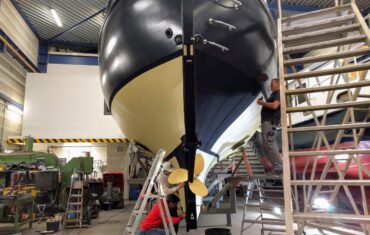
Once in Harlingen, the ship was hauled out, and we could inspect our antifouling. In October 2020, we covered the Baltic’s hull with eco-friendly Finsulate antifouling, and we were curious to see what it would look like after two years. Here and there, a few mussels had tried to get a grip on the seam between two pieces of Finsulate “carpet,” but on most of the hull, there was hardly any growth to be seen. It’s a result we’re very happy with and a great sign for the future.

After that, it was time for the SRF welders and carpenters to get to work on the railing and the pilot house. Initially, the Baltic had a flexible canvas sprayhood. Very suitable for warm climates, but in cold regions, more protection against the elements is necessary. That’s why the Baltic is getting a new heated pilot house, built from wood and finished with epoxy, fiberglass matting, and high-efficiency double glazing. The rear doors can be closed, but also completely removed if, for example, the engine needs to be replaced one day, or a refrigerator…


Due to how busy the shipyard is, the pilot house isn’t quite finished yet. It’s currently on a stand in the shed, and the final protective coatings will be applied after the summer break. Then the whole thing can be placed back on deck.
In the meantime, the ship went back into the water, and we sailed to Stavoren. In a shed at the railway harbor, our new aluminum masts were waiting for us. Two enormous mast profiles, 20.40m and 17.90m long.


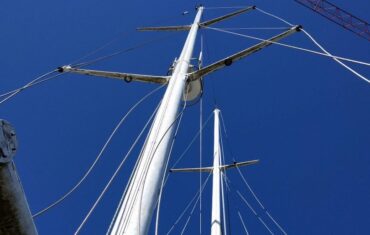
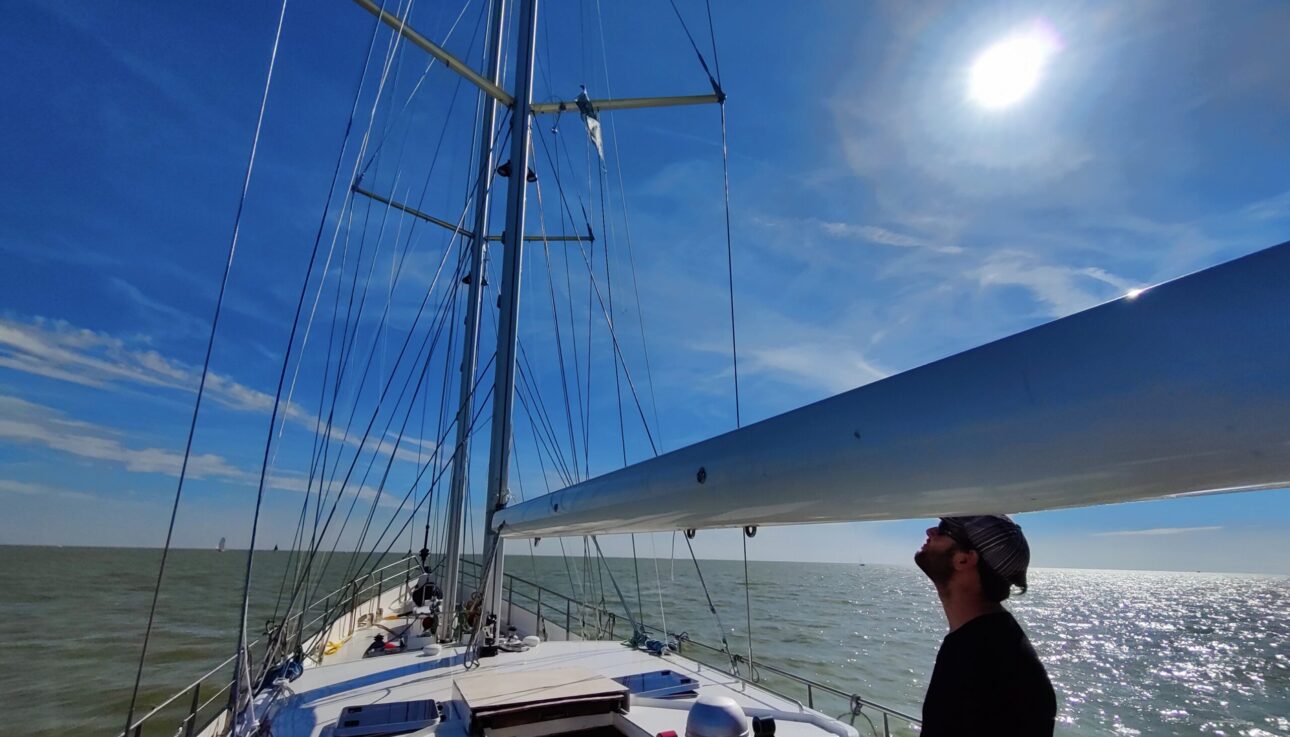
Wednesday, August 3, was finally the day, and after 4 years, the Baltic became a sailing ship again. The weather was excellent, and both masts were in place within 2 hours. Then the adjustment of the turnbuckles could begin, and the backstay and triatic stay were measured and made on-site.
By the way, it was a close call; the masts could have been knocked off within an hour due to a rather clumsy maneuver by a river cruise ship (which didn’t quite judge the available space correctly). But by the end of the day, we were able to take our first trip as a “new” sailing ship on the IJsselmeer.


In the coming days and weeks, we’ll be busy installing the blocks, stoppers, winches, and lines. And then we hope for a good wind to test out the new rigging (and the old sails).