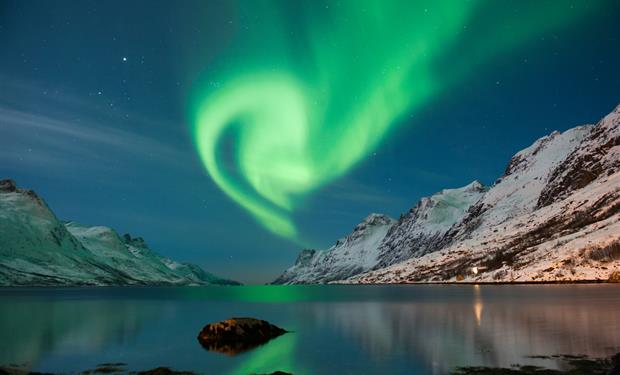
With patches of green, yellow, red, or purple, the Northern Lights dance across the sky. Suddenly they’re there—first gentle, then fierce and powerful. A few seconds later, they’ve vanished. Or have they?
The Northern Lights are hypnotic and captivating. When you see them, you can’t help but stare, mouth agape. When you don’t, they can keep you awake at night as you scan the horizon for a glimpse of green.
Aurora borealis: devil’s light?
In the past, the aurora borealis was seen as a bad, devilish omen, especially when it turned red. Some thought that the—flat—Earth was surrounded by a sea of fire that would engulf the land. Others thought they saw fox tails burning in the sky.
The lights are formed at an altitude of 100 to 250 km above the Earth’s surface from electrically charged particles. These are carried by the solar wind and attracted to the magnetic North and South Poles. Near the poles, these particles collide with oxygen and nitrogen. The result is the magical, dancing light we call aurora borealis (or australis, in the Southern Hemisphere).
Chances of seeing the Northern Lights
By keeping a close eye on the solar wind, we get an indication of how many particles are active and how likely it is that we’ll see the Northern Lights. During our Northern Lights trips, we check this every day and try to be in the right place at the right time.
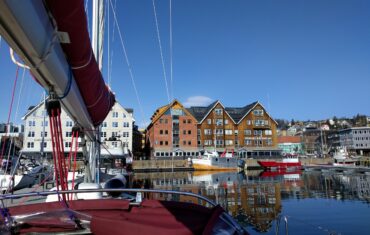
But of course, it remains a capricious phenomenon that’s difficult to predict with certainty—even for scientists. In any case, the region around Tromsø is the area with the most Northern Lights sightings in Europe. That’s why we start our search there.
Will you join our hunt for the famous Aurora Borealis?
 We’re planning a Northern Lights photography trip (including a workshop in Tromsø).
Want to be the first to know? Are you interested? Let us know right now.