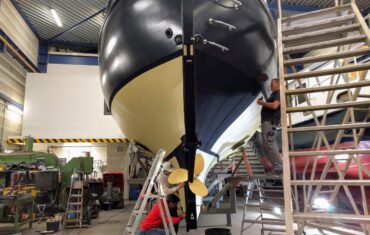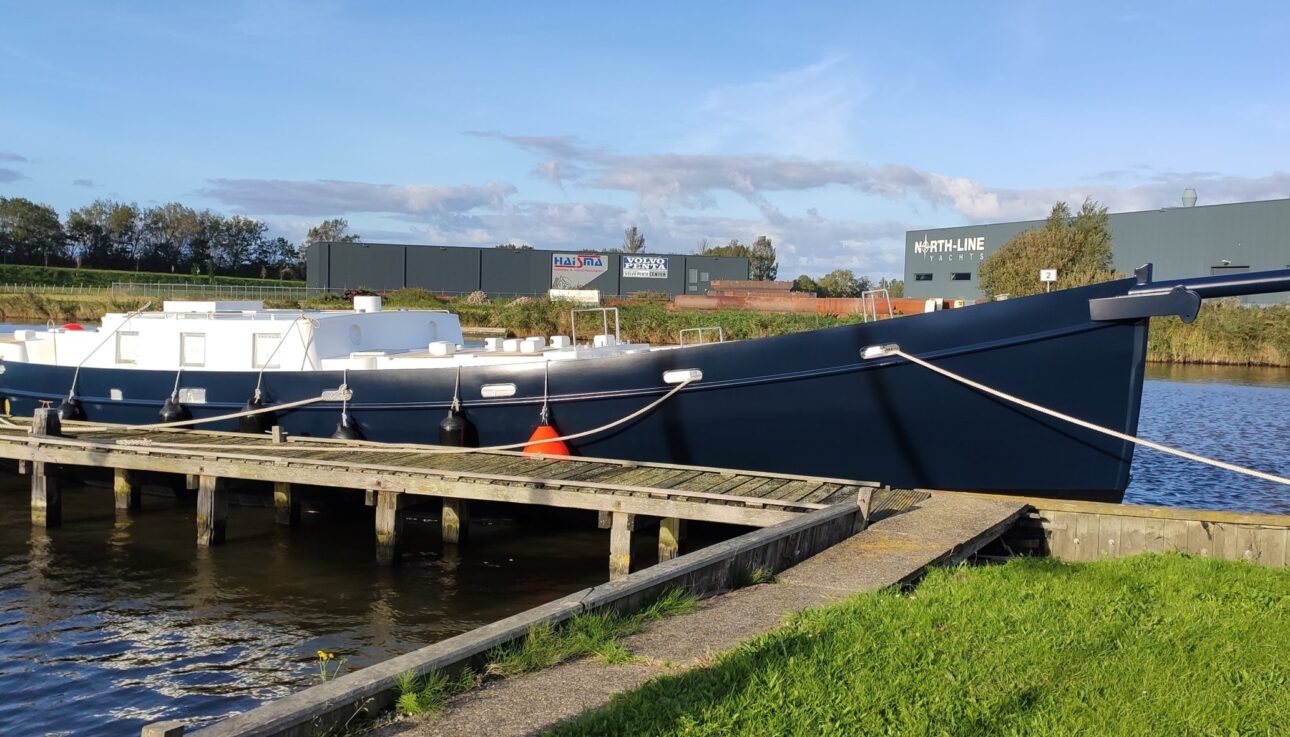

After 10 months and 10 days on dry land, the Baltic headed back out and into the water. In the days leading up to it, we worked like crazy to seal all the ‘holes’: seven escape hatches (each with 23 tiny bolts – meaning drilling 7×23 holes in the new paint), the ventilation pipes, the salon windows, seven hatches for the lockers, the swim ladder at the stern, and the steering rods from the cylinders to the rudder.
Fenders were inflated and fitted with lines, and the anchor winch went back on board. While hanging in the crane, the ‘support spots’ (where the ship rested on the cradle) got a quick coat of primer and a patch of antifouling. Then, she made the big swing into the water.

As soon as the keel disappeared underwater, Marijn stepped on board to check if all the seacocks and valves were properly watertight. One of the valves is currently ’empty,’ so if water were to come through, it wouldn’t flow into a pipe, but straight into the engine room. The blind flange that was supposed to prevent that (a thick disc to seal the whole thing extra tight) had gotten stuck somewhere in the ordering process…

With that in mind, Marijn crawled inside through an escape hatch. Less than two seconds later, he heard the water—indeed—already seeping in through that empty valve. Quick action and some extra brute force on the bolts prevented the engine room from flooding.
Next, he checked the propeller shaft, because we had naturally taken that completely apart and renewed it as well. Fortunately, the seal turned out to be fine. After that, we could lower the Baltic further into the water with peace of mind. And then she was floating again, finally!


Ideally, you’d start the engine right away, but it was completely dismantled and moved earlier this year. Since it’s difficult to test a marine engine on dry land (you cool it with raw water) and we didn’t have a single drop of diesel on board yet, the Baltic was pushed through the canal for the first few hundred yards to its new mooring spot.