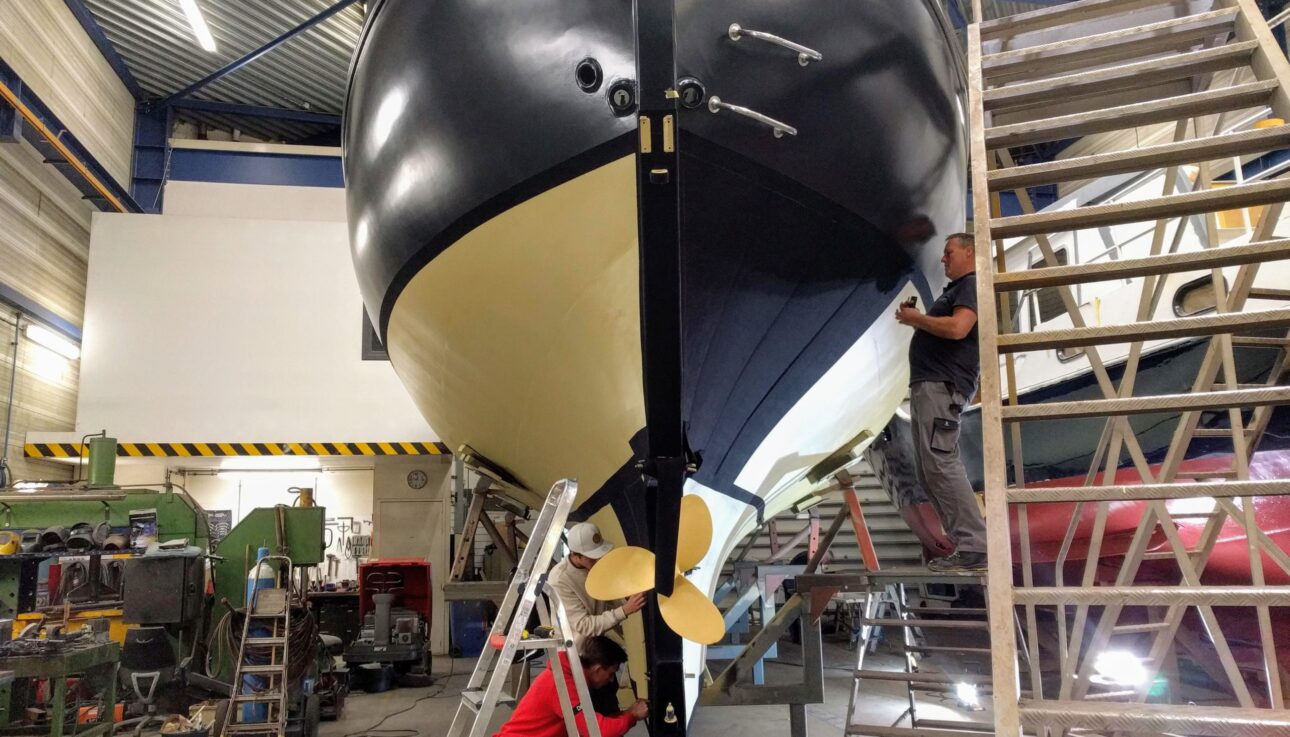
When you step aboard with us, the Baltic’s underwater hull will probably barely catch your eye. You’ll focus your attention on the bow, the deck, or the masts. And the rest is underwater. Still, it’s worth paying a little extra attention to it.
In the water—whether fresh, salt, or brackish—all sorts of organisms naturally live. These mussels, algae, and barnacles are constantly looking for places to settle, and a ship’s hull is a favorite.
If one settles, more will follow, and before you know it, your entire underwater hull is colonized by marine plants and animals. That’s not a problem in itself, except that your ship will move slower through the water with all those hitchhikers.

Antifouling
To prevent fouling, every ship has antifouling applied below the waterline. Traditionally, this has always been a toxic or copper-based paint that slowly dissolves in the water over 1-2 years. And then they just apply a new coat…
Unacceptable, we think. We want to show you how beautiful, special, and vulnerable nature is in the polar regions. So, a toxic antifouling is not an option for us. And so, we started looking for environmentally friendly alternatives to antifouling.
Sustainable Alternatives
We investigated a whole range of eco-friendly antifoulings. From silicone (not suitable for sailing through drift ice) to epoxy and vinyl coatings (suitable for the cold, but requiring underwater cleaning every quarter, which isn’t very appealing in Spitsbergen). And even ultrasonic systems were reviewed (very effective, but they might disrupt communication between whales or dolphins).
Every sustainable antifouling alternative seemed to have less sustainable or practical drawbacks. Until we discovered Finsulate’s (award-winning) “shark skin.”
Rik Breur, the material’s developer, researched how nature itself solves the fouling problem. On a shark’s skin, or on sea urchins, for example, you never see hitchhiking mussels or algae. That’s due to the tiny spines on their skin.
Finsulate’s Sea Urchin
This microfiber structure is mimicked in Finsulate’s antifouling film (biomimicry, in other words). The unique sea urchin wrap feels like a soft carpet. But thanks to the tiny spines, mussels and algae cannot cling to the ship’s hull.
After extensive tests by TNO, MARIN, and TU Delft, we were convinced. Finsulate’s antifouling wrap is non-toxic, suitable for cold (and warm) regions, and will last us at least seven years, which saves a lot of dry-docking.
As the first charter ship in the Netherlands, the Baltic will set sail with a 100% eco-friendly ‘carpet’ on its underwater hull. Curious about what other sustainable choices we’ve made (or will make)? Check out this extensive blog about sustainability aboard our sailboat.


.