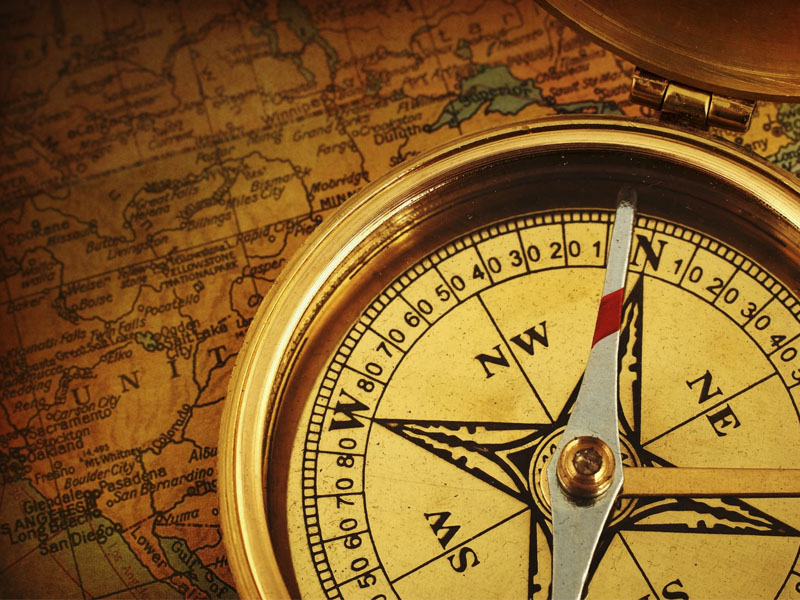
Steering a ship seems easy. You’re given a course (or you figure it out yourself), you look at the compass, and make sure the correct number aligns precisely with the lubber line. And then it’s ‘straight ahead’. No traffic lights turning red, curbs to avoid, or signs indicating how fast you can (or cannot) go.
But it’s not that simple, of course. The wind often comes from the direction you want to go. Or it’s too light or too strong. The waves push you off course, or the current is going the wrong way. Before you know it, you’re constantly adjusting. Half an hour at the helm can sometimes be hard work.
Aside from all these variables, which can change from minute to minute, there’s another factor that can prevent you from going in the direction you want: magnetic variation. Everyone learns in school that a compass needle always points north, but that’s not entirely true. There are countless places on Earth where magnetic fields cause the compass to indicate an incorrect direction.
When the difference is 1 or 2 degrees, as in the Baltic Sea, the impact is usually not very significant. But when we left Cape Verde a few years ago, we had a variation of 11 degrees. Halfway across the South Atlantic, it increased to 23. So we were constantly calculating, because while the variation is indicated on the nautical chart, it changes every year, becoming more or less. And it’s often very localized.
If the helmsman steers a precise course of 205, you’ll end up somewhere completely different than if you plot a course of 205 degrees on the chart. That 205 on the compass suddenly turns out to be 182 degrees on the chart. And with that, you could easily end up on the wrong side of the Antarctic Peninsula. Or worse.