Discovering, experiencing, and enjoying is the motto of our sailing trips to the Arctic regions. And naturally, we want to keep doing that—together with you—for as long as possible. For us, it’s a given that we don’t just run our trips as sustainably as possible, but our ship as well. The major refit of our sailing ship, the ‘Baltic,’ offered us a perfect opportunity to examine every part of the vessel and see where we could make more sustainable choices. And there are quite a lot of them.
Some sustainable choices are relatively simple; in the household area, we ‘just’ adopt all the sustainable habits from home, such as organic and plant-based food, LED lighting, organic cotton bedding, eco-friendly cleaning products, and of course, waste separation (which sometimes proves to be a challenge in foreign ports).
Others sometimes require more technical research, such as the antifouling, the solar panels, and the treatment system for toilet water. Below, you can read about the choices and considerations we’ve made.
Sustainable Choices in the Head
In the showers, we’ve installed a water-saving showerhead. It uses less water but provides the same water pressure and experience as a ‘regular’ shower. Next to the showerhead, you’ll find ecological soap. Since all the water that goes down the sink and shower drain (called ‘gray water’ on board) eventually ends up in the sea, we think it’s important that the products are biodegradable (so you won’t see fish blowing bubbles swimming by later).
And while we’re in the smallest room on the ship: as soon as you flush the toilet, an army of bacteria gets to work in our wastewater treatment plant. This ‘black water’ goes through the treatment plant in three stages and comes out clean. You can’t drink it, but it’s a lot purer than a regular holding tank. You’ll understand that—partly because of this process—the cleaning products for our toilet are also biodegradable.
Below the Waterline: Not Harmful to Marine Life
But it’s not just cleaning products that can pose a threat to marine life; paint can too. The hull of the ship is, of course, mostly underwater, providing a nice resting spot for mussels and barnacles. That’s fine for marine life, but a bit less convenient for us. Because the more growth there is on the hull, the slower we move through the water.
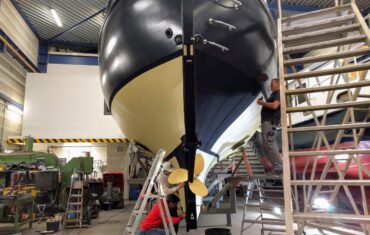
Almost all ships (and oil rigs, for that matter) therefore treat their underwater hull with an antifouling paint (literally: anti-growth paint). The most effective paint contains copper and is self-polishing. This means it’s quite toxic and completely dissolves into the water after 1 or 2 years.
We absolutely wanted an eco-friendly alternative to antifouling. Because throwing dozens of liters of toxic paint into the water every year is simply not an option. After weighing various options, we applied Finsulate antifouling wrap to the underwater hull. It’s not only 100% eco-friendly, but it also lasts much longer (7-10 years). So, it’s doubly sustainable.

Fossil-Free Fuel
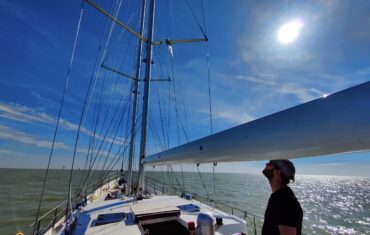
Just above the waterline, at the rear of the ship, is the exhaust for our main engine and generator. We also want to minimize our impact on the environment in terms of CO2 emissions. On one hand, we do this by keeping the engine off and hoisting the sails; on the other, by minimizing our power consumption (using LED lighting and solar-powered ventilation, among other things).
Still, there are always moments when that’s not possible (no wind, no sun). For those cases where we need to use the diesel engine or generator, we’ve filled our fuel tanks with Neste MY Renewable Diesel (HVO100). It is completely fossil-free, renewable, and low-emission. Compared to ‘regular’ diesel, we save about 6,000 kg of CO2 emissions per 2,000-liter tank, which is equivalent to about 6,000 showers, the production of 260 pairs of jeans, or 900,000 plastic bags (source).

In addition to energy, the main engine and generator also produce a lot of heat. We use this heat to pre-warm the water for the radiators. This way, the heater itself (which also runs on renewable diesel) has to produce significantly less heat to ensure a comfortable temperature throughout the ship.
The Indoor Climate: Insulation and Ventilation
But a comfortable temperature starts with good insulation. We chose CFC-free two-component spray foam (instead of regular glass or rock wool). One of the big advantages is that the foam sits tightly against the ship’s hull as a single unit (so no more chance of rust formation). It also fills all the tricky corners and crevices, making it the most effective form of insulation. Together with active ventilation in each individual room, this ensures a pleasant and healthy indoor climate.

In the salon, we replaced the 6 large portholes—nostalgic as they were—with ‘regular’ square panes of thermally toughened, double-glazed glass (6 + 5 mm). Because portholes have a thick metal frame with large toggles, they form a so-called ‘thermal bridge’ when it’s colder outside than inside.
Especially in the polar regions, the temperature differences between inside and outside are large, which means portholes always cause condensation and heat leaks. Our new windows are set in a stainless steel frame that doesn’t protrude further inward than the window itself. This way, we prevent thermal bridges and condensation.


Power Supply: Lithium Batteries
Part of the salon is set up as a galley. We’re replacing the gas stove (with gas oven) that was here with an induction cooktop and an electric oven, so we’re completely gas-free and don’t have to use non-sustainable fuels. Besides, we don’t think it’s a good idea to have gas cylinders and open flames on a ship anyway, due to the risk of fire and explosion. So, in addition to being more sustainable, this is also safer.
But an induction cooktop requires a good 230V power supply, which can be a tricky point on many sailing ships (and sometimes in older houses). We handle this first and foremost with a good inverter that regulates the peaks and valleys in consumption.
The power itself—which is generated when the main engine or generator is running, or via shore power—is stored in lithium batteries. These batteries have a significantly longer lifespan than lead-acid batteries (4 or 5 times as long), are safer, and can be discharged much more deeply (up to 90%, compared to 30% for lead-acid). As a result, we don’t have to recharge them as often and they will last for years.

Use of Solar Energy
In addition to the lithium batteries, the solar panels on the salon roof also provide the necessary energy for life on board. These solar panels are walkable. They have a slightly lower yield because of this, but they still make a great contribution to the power supply, while allowing us to safely stow the mizzen sail.
By the time the mizzen (the aft mast on the ship) needs a new sail, we want to see if we can have a sail made with integrated solar panels. That would, of course, significantly increase the total surface area of solar panels.

Finally, we are researching which wind generator we can place on the ship. There are many possibilities in that area. We are considering not only the yield (and the price, of course) but also the noise level. Anyone who has ever walked through a marina on a windy day understands why. So, this will be a search for the most optimal balance between yield and comfort. We’re not going to remote areas to disturb the peace there. In short: to be continued.
Sustainable Choices in the Future
For now, these are the sustainable choices we’ve made. We’ve already implemented some of them, and we’ll realize the rest in the coming years. In a few years, we want to take a closer look at the propulsion. We hope to be able to install an electric (auxiliary) motor then that offers enough (storage) capacity to sail in remote areas as well. That’s also an interesting puzzle, but for the time being, we’ve got plenty to do with the current wish list and to-do list.