The depth sounder can now display a reading again, which roughly means we are no longer in the Atlantic Ocean. There, the depth was more than 4000 meters, which the depth sounder could no longer measure. Now we are back at a good 250 meters. The crossing of the Bay of Biscay is thus definitively completed.
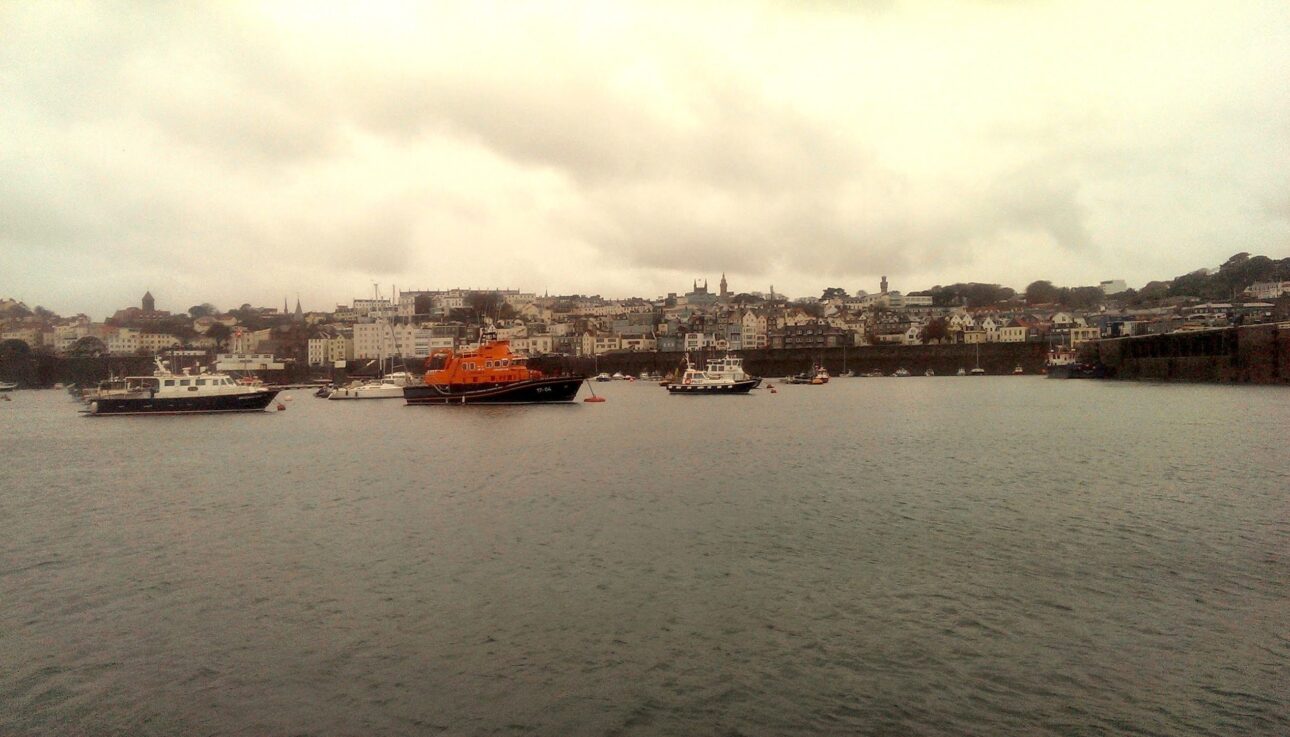
Due to the predicted strong headwind in the Channel, we set course for Guernsey. My last night watch has begun, and we are calmly sailing towards the island. In the distance, we suddenly see a faint glow that appears and disappears intermittently.
Now, there is indeed land in that direction, complete with a lighthouse, but it’s actually still too far away to be visible. Also, the light is too irregular to be a lighthouse. So, it’s probably a ship, and not a very large one.
We check the AIS, a system ships use to exchange information about course, position, and speed, among other things, but we can’t find anything, and the radar also doesn’t indicate anything in that direction. So, we try to figure out what it could be by looking closely.
Over the past few days, we’ve seen a wide range of bizarre navigation lights on fishing vessels, with rapidly flashing orange rotating beacons being the strangest, so nothing surprises us anymore. But for now, we can’t quite determine if it’s red, yellow, or a bit of both.
Meanwhile, we’ve seen a very faint blip on the radar a few times, less than four miles away. The bearing on the radar has remained the same for a while, but the distance is getting smaller and smaller. Time to do something.
First Mate Ali decides we’d better divert and changes our course 30 degrees to port. We try to maintain this for a while, but soon it becomes clear that we are now sailing at the same speed and in the same direction as the still-undefined object. So, we won’t get past it, and besides, we’re now heading in the wrong direction. We decide to try a different approach.
Fortunately, the bearing now changes, and we are no longer on a collision course. However, our courses will cross so closely that we will continue to follow the ship on radar and, of course, with binoculars, with full alertness.
It feels like an eternity, but then we finally see a green light next to the white one. So, we are passing the ship well, but close enough that we decide to shine a spotlight on it. Only now do we finally see that it is a sailing yacht.
For me, it’s an incredibly valuable lesson to experience that as a small yacht, you are practically invisible to a large ship, and you can have the best radar reflector, but it’s certainly no guarantee that you’ll show up on the relevant screen. Always go out with an AIS, because if they had had one, we would have known much sooner what we were dealing with and could have kept our distance much more easily.