At 8 PM, we cast off the lines in Punta Arenas. As we sail away, the sun sets the clouds and cirrus wisps in a light pink glow. We hoist the sails and head southeast.
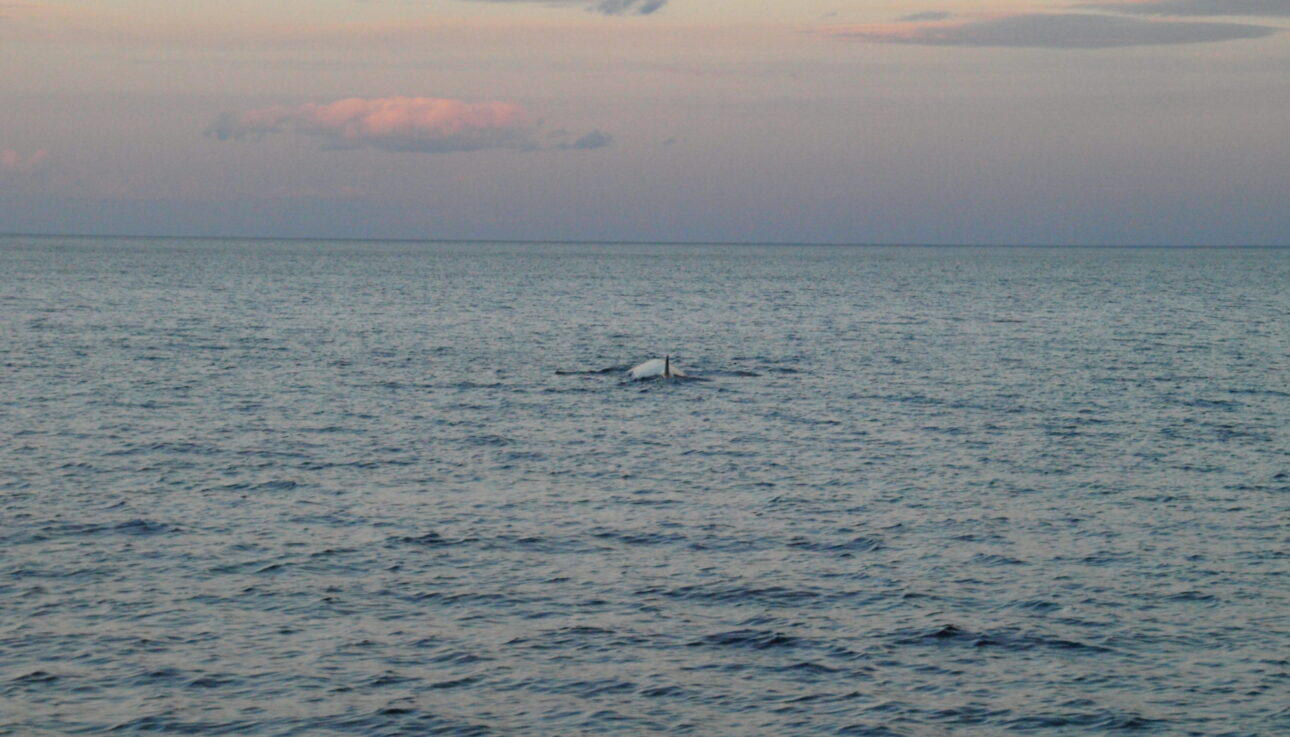
After 2 hours of sailing, we spot a sort of fountain further ahead in a bay. Three gray whales swim slowly in front of us. Every now and then, they spray a few meters above the water, arch their backs, show their dorsal fins, and disappear again with a graceful dive.
We follow the whales for half an hour, then they turn around and disappear into the distance with a few strokes. We start the engine again and continue sailing through the Strait of Magellan.
At the start of my watch, at midnight, it’s dead calm. The last lighthouse can be seen on the shore. For the few boats that pass through here, they haven’t bothered to light the waterway further ahead. When the clouds also block the moonlight, it’s pitch black.
The main waterway veers off to the northwest, in a straight line toward the Pacific Ocean. We want to go south, through a narrower and more sheltered channel. But before we can enter, we have to cross the wide water where the inlet and the channel meet. The wind and current both come from the Pacific (which is usually not peaceful at all) toward us.
When I hand over the helm to guest Hub, there’s 22 knots of wind. “The water is getting noticeably rougher,” I tell him, and dive inside to warm up. In the wheelhouse, I take another look at the wind gauge: 34 knots. I nudge the mate sitting on the bench, and together we rush outside to put a reef in the mainsail and the mizzen.
Less than two hours ago, it was completely calm; now we were in the middle of a heavy storm with rough seas and gusts up to gale force 8 (40 kn). That’s how fast it can go among the fjords, where the wind is sometimes completely blocked by the mountains and other times goes screaming through the tunnels formed by those same mountains.